
The more autonomous an agent gets, the more it matters how good the points are where humans can step in - not whether we get rid of them.
A customer wants a refund. The refund agent proposes refund_order, the parameters are correct, permissions are checked. And then: an approval banner. The workflow pauses. Nothing happens until a human clicks “Confirm”.
The first reflex? “Why can’t it just do it?”
I know that reflex. We build agents so they get things done for us - and then we put a stop sign in their way. It feels like friction. Like a step backwards. Like the opposite of automation. The thing is: refund_order moves money. Real money. And an agent that can move money autonomously isn’t a feature - it’s a risk.
The requiresApproval: true in the refund agent’s tool catalog is no accident. It’s an architectural decision - in the previous post I introduced the policy gate as part of the “Definition of Done” for agent tools. There, require_approval was one item among many. Here, it takes center stage.

Pausing isn’t a bug, it’s governance
An approval point in an agent system follows a simple principle: the agent proposes, the human decides, the system executes. Three steps, clear responsibility. That sounds like overhead - but it’s architecture.
It’s important to separate two concepts that often get lumped together: elicitation and governance gates. Elicitation means the agent actively asks for information - “Which order number do you mean?” or “Should I generate the test report as PDF or Markdown?”. The agent needs input to keep working. A governance gate is something else: the system enforces a sign-off before an irreversible action is executed. Not because the agent is unsure, but because the action requires it.
Elicitation is UX. Governance is security architecture.
Pull request reviews make a useful analogy: yes, PR reviews cost time. Yes, they’re a bottleneck. And yet they’re standard in almost every professional team - because the damage from uncontrolled code in production outweighs the overhead. Approval gates for agents are the same principle: an enforced stopping point before a state change that can’t simply be undone.
Anthropic’s analysis of Claude Code offers an interesting observation here: the model pauses on its own in over 16% of complex turns - more than twice as often as humans interrupt the agent (around 7%). The model recognizes its own uncertainty and acts on it. It doesn’t wait to be stopped - it stops itself.

Anthropic’s “Building Effective Agents” recommends exactly that: agents should be able to pause at checkpoints and wait for human feedback. The philosophy behind it boils down to a principle I consider central - least agency: give the agent only as much autonomy as the task actually requires. No more.
If you looked closely at my post on evals, you might remember: the contract explicitly said User approval: the workflow should pause - as a deliberate design decision, not a stopgap.

Pause/resume is to agent systems what pull request reviews are to code: not optional, but quality assurance.
When approval is mandatory - and when it isn’t
Not every agent action needs a human. Asking a human to sign off on lookup_order would be absurd. But letting refund_order go through without a sign-off would be negligent. The question isn’t binary - it’s a tiered model.
| Risk tier | Example | Action |
|---|---|---|
| Read-only | lookup_order, faq_search |
Auto-allow |
| Low-risk mutation | reset_password |
Log, no approval |
| High-risk mutation | refund_order |
Approval required |
| Irreversible | delete_account |
Approval + four-eyes principle |
Read-only is harmless - the agent reads data but doesn’t change any state. Here, an approval gate only slows down the flow without adding any security. Low-risk mutations change state, but the impact is limited and reversible. If a password gets reset, users can reset it again on their own. Logging is enough to keep the audit trail complete. High-risk mutations move money, change contracts or touch sensitive data - here a human has to explicitly sign off before the system executes. And irreversible actions like account deletions need not just approval, but a four-eyes principle: a second person confirms what the first one approved.
Which tool lands in which tier isn’t an exact science - it’s a deliberate product decision. In the refund agent, it looks like this:
This tiered model isn’t a theoretical framework. Starting in August 2026, regulators care about it, too.
EU AI Act Art. 14: five mandatory capabilities from August 2, 2026
For high-risk systems, the EU AI Act prescribes five concrete human oversight capabilities:
- Understand & monitor - capacities, limitations and anomaly detection (Art. 14(4)(a))
- Automation bias awareness - awareness of over-reliance on AI output (Art. 14(4)(b))
- Correctly interpret output - using interpretation tools (Art. 14(4)(c))
- Override or reverse - being able to reverse or disregard any AI decision (Art. 14(4)(d))
- Intervene or stop - safe halt via a stop button or similar (Art. 14(4)(e))
Worth noting: Art. 14(4)(b) explicitly addresses automation bias - behavioral science in hard law. Violations can cost up to EUR 15 million or 3% of global annual turnover.
Not every action needs a human. But every risky action needs the possibility of a human. And that has to be designed into the architecture - not bolted on afterwards.
How an approval flow works technically
From the tiered model to the implementation. The basic pattern is surprisingly simple - the complexity isn’t where most people expect it.
The pattern
Every approval flow follows the same sequence: the agent formulates a tool intent. A policy gate checks whether this intent requires approval. If so, execution pauses, the intent lands in an approval queue, a human decides - and only then is the tool call actually executed. Or not.
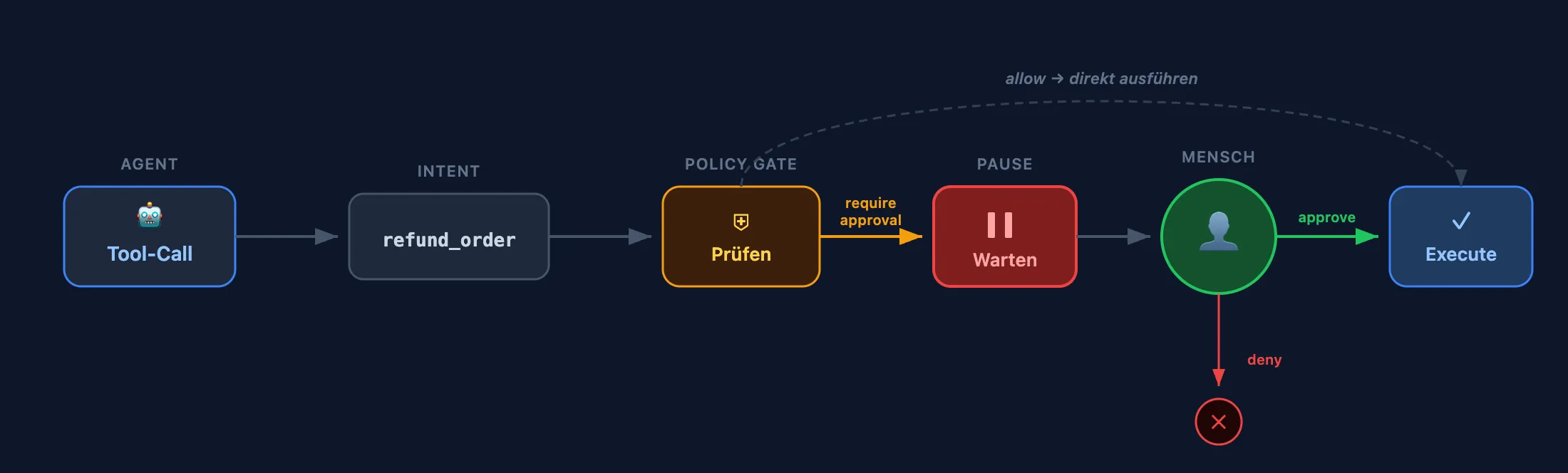
In code, it takes remarkably little. In the Vercel AI SDK, a single flag on the tool definition is enough:
const refundOrder = tool({
  description: 'Process a refund for an order',
  parameters: z.object({
    orderId: z.string(),
    reason: z.string(),
  }),
  needsApproval: true,
  execute: async ({ orderId, reason }) => {
    return await processRefund(orderId, reason);
  },
});
needsApproval: true - that’s all. The server waits until the client sends a decision via addToolApprovalResponse. Approved? The tool call is executed. Denied? The agent gets the rejection as context and can respond.
The real challenge isn’t the pattern itself, but what has to happen around it: state persistence, crash recovery, and the question of what happens to an approval that only comes in after three hours.
SDK comparison
| Dimension | Vercel AI SDK | OpenAI Agents SDK | LangGraph | Temporal |
|---|---|---|---|---|
| Pause mechanism | needsApproval on tool |
needs_approval on tool |
interrupt() in node |
workflow.wait_condition() |
| State persistence | Client state (React) | Explicit via RunState.to_json() |
Automatic checkpointer | Automatic event history |
| Crash recovery | Session-dependent | Manual (rehydrate from DB) | Checkpointer-dependent | Fully automatic replay |
| Best fit | React/Next.js chat UIs | Lightweight agent tools | Graph-based workflows | Enterprise long-running |
Vercel and OpenAI rely on declarative flags right on the tool - the easiest way in. LangGraph checkpoints automatically, but code before an interrupt() has to be idempotent, because the entire node runs from the start on resume. Temporal plays in a different league: practically unlimited wait time, fully automatic replay after a crash, signals for external decisions.
Approval with the OpenAI Agents SDK (Python)
result = await Runner.run(agent, "Delete temp files no longer needed.")
if result.interruptions:
    state = result.to_state()
    serialized = state.to_json()        # persist to DB for async approval
    # ... later, after human decision ...
    state = RunState.from_json(agent, serialized)
    state.approve(result.interruptions[0])
    result = await Runner.run(agent, state)
MCP now offers a relevant primitive, too: elicitation lets an MCP server wait for user input during tool execution - primarily for missing information, not for governance. But the underlying pause/resume pattern (accept, decline, cancel) is the same. MCP still lacks a standardized governance gate protocol - but the primitive for it is there.
What the approver needs to see
Technically, all of this works. But an approval flow is only as good as the information the approver gets. Who wants what, on which object, why, with what risk - that has to be clear at a glance. Not the entire chat history, not every intermediate step of the agent conversation. Just what you need to decide, condensed.
In the refund agent, it looks like this: an approval banner shows the tool name and arguments as JSON. Approve or deny. And every decision becomes part of a structured audit trail - with actor, subject, approvalOutcome, approvalId and prompt version hash.
The approval flow isn’t a technical problem. It’s a product problem: what does a human need to make the right decision in three seconds?
Durable execution
In the demo, session state is enough. In production, it isn’t. Approvals that take hours or days need durable execution. A browser tab that gets closed must not send an approved refund into the void.
The rubber-stamp problem: when approval becomes a farce
We now know how approval flows are built. The question isn’t whether we can build them - but whether they work. The most honest counterargument is obvious: what good is an approval step if the human waves everything through anyway?
The answer is uncomfortable. Because that’s exactly what happens - and it happens systematically.
Automation complacency
The phenomenon has a name: automation complacency. The more reliably a system works, the less critically the human checks its output. That’s not an individual failure, but a well-documented cognitive effect. And it gets worse the better the AI gets.
The numbers are clear. Clinical decision support systems show override rates of 90-95% - nine out of ten warnings get clicked away. Part of that is rational, because many alerts are clinically irrelevant. But that’s exactly the problem: if 90% of warnings are noise, the system trains people to stop looking. A JAMA study with 457 clinicians went further: when the AI deliberately gave flawed recommendations, diagnostic accuracy dropped from 73% to 61.7%. The AI didn’t make the decisions better - it made the humans worse.
When rubber-stamping becomes system failure
The Dutch childcare benefits scandal of 2021 shows what happens when rubber-stamping escalates at the administrative level. Technically, the system was HITL - caseworkers had to review and approve the ML-based fraud assessments. In practice, nobody questioned the output. Thousands of families were wrongly labeled as fraudsters. The government resigned.
In 2023, the European Court of Justice drew the legal consequence in the SCHUFA ruling (C-634/21): if a human merely waves the AI output through without substantive review, that counts as “solely automated decision-making” under GDPR Art. 22. Rubber-stamping isn’t just a UX problem - it’s a compliance risk.
Design patterns against rubber-stamping
But research also shows: rubber-stamping isn’t a law of nature. It’s a design problem.
Cognitive forcing functions (Buçinca et al. 2021) force the reviewer to form an independent judgment before the AI recommendation becomes visible. It sounds trivial, but it has the strongest effect on overreliance.
Variable challenge injection mixes known good/bad items into the review queue - so-called trap tasks. If you get three planted cases wrong in a row, you get feedback. That keeps attention up.
Mandatory justification replaces the approve button with a structured justification field. Not “Approve/Reject”, but “What exactly did you check, and why is the result correct?”
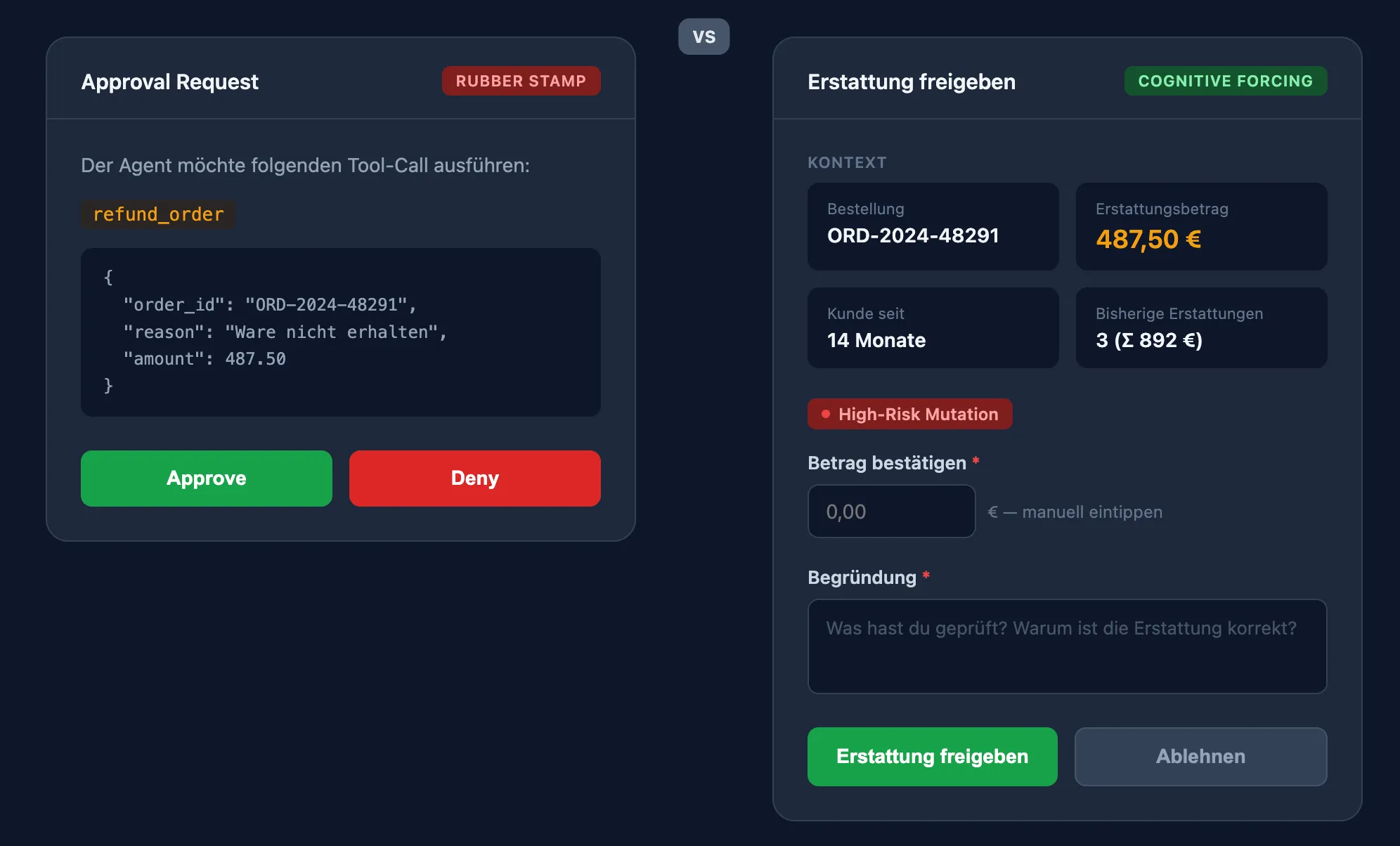
A 2025 systematic review (Springer) distills the core finding: AI explanations alone - i.e. transparency about why the AI decided the way it did - aren’t enough. The most effective lever is active user engagement. The human has to work, not just watch.
And this is where it gets uncomfortable: Buçinca et al. found that precisely the designs that reduced overreliance the most got the worst subjective ratings from users. Users didn’t like the cognitive forcing functions. Good approval design is uncomfortable - by design. If you design the approval process so that it feels good, you probably haven’t solved the problem.
Anyone who sees HITL as a UX bug has never read a production incident report.
Control isn’t a step backwards
The question was never “HITL yes or no”. The question is: how much autonomy can each action handle - and how does that change over time?
The risk tier model determines which tool needs which gate. But there’s a second axis: how much oversight does the overall system need? A new tool in an untested domain starts in audit mode - the human reviews every action. With measured performance (accuracy, override frequency, exception rates), the system can gradually move to assist mode: the AI acts, the human monitors. And at some point it operates almost autonomously within clearly defined boundaries - but the boundaries remain enforced by the architecture, not built on trust.
In 2026, Jakob Nielsen made an uncomfortable observation: verifying AI output is often cognitively harder than producing it yourself. But that verification is exactly the role left for humans. And it becomes all the more important the better the systems get.
The infrastructure for controlled autonomy is there. The SDKs deliver the primitives. The only question left is whether we use them.
An agent that doesn’t know when to pause isn’t an autonomous agent - it’s an uncontrolled process.